Commercial Rooftop Solar Systems

Commercial Rooftop Solar for IPPs and Energy Asset Owners

Rooftop solar is often one of the most practical options for onsite generation at commercial and industrial properties. For independent power producers (IPPs), energy asset owners, and asset managers, large rooftop systems can put underutilized space to productive use while supporting project economics, energy cost management, and long-term asset value.

Core Development Group provides Engineering, Procurement, and Construction (EPC) services for large commercial and industrial rooftop solar projects. Our team supports defined project scopes from design and procurement through construction and project closeout.

Rooftop Solar Benefits

The value of a commercial rooftop solar project depends on roof conditions, system design, interconnection requirements, incentive eligibility, market structure, and ownership objectives. Our team works with IPPs, energy asset owners and managers, and commercial property owners to define the construction and project management scope required to move each project through commissioning and closeout.

Potential Tax
Incentives

Improved Project
Economics

Long-Term
Revenue Potential

Energy Cost
Management

Long-Term Asset
Performance & value

Sustainability
Objectives

Project Economics and Long-Term Value

Commercial rooftop solar can create long-term financial and operational value for IPPs, energy asset owners and managers, commercial property owners, and large corporations. The economics of each project depend on system size, roof and structural conditions, anticipated energy production, interconnection requirements, market structure, available incentives, and ownership objectives.

For energy asset owners, rooftop solar may support long-term revenue potential and asset value. For commercial property owners and large corporations, on-site generation may help manage energy costs and advance sustainability objectives. Each opportunity should be evaluated based on its specific site, commercial terms, operating requirements, and long-term goals.

Experience Delivering Commercial Rooftop Solar

Large commercial rooftop solar projects require experienced oversight across structural conditions, roof warranties, electrical systems, permitting, interconnection, site access, equipment staging, construction sequencing, and ongoing facility operations. With more than a decade of commercial and industrial solar experience, our team provides the project management, construction management, and field resources needed to address these requirements.

From defined construction scopes to broader project delivery, we help IPPs, energy asset owners and managers, commercial property owners, and large corporations reduce risk and move rooftop solar projects through commissioning and project closeout.

A Flexible Rooftop Solar Project Continuum

Every rooftop solar project has different requirements and may reach our team at a different stage. Some clients engage us for construction or construction management after design and major equipment procurement are substantially complete; others require broader support across design, procurement, permitting, interconnection, project management, construction, commissioning, and closeout. Core Development Group can be engaged at any point, with a scope tailored to the project’s status, requirements, and ownership objectives.

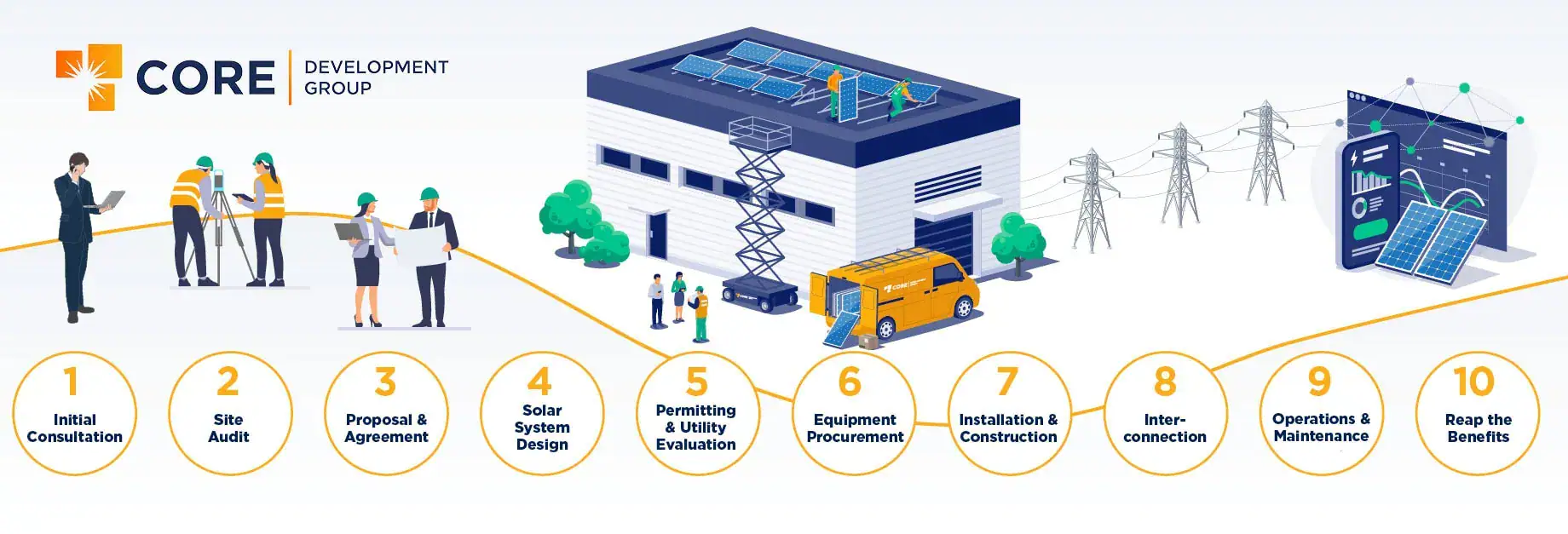
Cdg rooftopsolar processdiagram 2
Telephone Consultation
X
Determine your needs and rooftop infrastructure, i.e. size of your roof, regulatory environment, shading situation, condition and age of rooftop, and initial discussions on potential tax credits, rebates and incentives with their financial impact. This step includes data collection of a variety of documents to understand client needs and site conditions.
Site Audit
X
Meet onsite to validate conditions required to build a proposal.
Proposal and Agreement
X
Determine client needs and agree upon the proposal
Solar System Design
X
Starting with conceptual engineering design and proceed to a fully engineered design after conducting a site audit to understand the structural, electrical, and environmental situation so that a system can be customized to fit each project to maximize energy production, reduce costs, and optimize performance based on rate structures and energy usage patterns.
Permitting and Utility evaluation
X
The process of gaining approval from local, regional and potentially state regulatory bodies for the design and construction of the rooftop solar system along with the local distribution utility studying the proposed solar project to identify any potential impacts it will have on the grid and grant permission to interconnect into the utility electric distribution system.
Procurement of equipment
X
Confirm, purchase, and delivery of solar panels, inverters, racking systems, inverters, and other components based on project requirements.
Construction
X
Delivery of equipment, lifting to rooftop, installing appropriate racking, ballast, and solar panels, connecting to arrays, setting up inverters and electrical systems, and monitoring systems for performance tracking.
Interconnection
X
The process of connecting a solar system to the electrical grid.
Solar System Operations and Maintenance (O&M)
X
to ensure the system is optimized and operates efficiently over the life of a system.
Benefits
X
Save money every year, increase property value, tax credits, re and other incentives, demonstrate commitment to sustainability responsibilities, potential for quick payback, price certainty with predictable electrical rates for decades.
Cdg rooftopsolar processdiagram 2

Steps for Acquiring a Solar Rooftop System

  1. Telephone Consultation – Determine your needs and rooftop infrastructure, i.e. size of your roof, regulatory environment, shading situation, condition and age of rooftop, and initial discussions on potential tax credits, rebates and incentives with their financial impact. This step includes data collection of a variety of documents to understand client needs and site conditions.
  2. Site Audit – Meet onsite to validate conditions required to build a proposal.
  3. Proposal and Agreement – Determine client needs and agree upon the proposal
  4. Solar System Design – Starting with conceptual engineering design and proceed to a fully engineered design after conducting a site audit to understand the structural, electrical, and environmental situation so that a system can be customized to fit each project to maximize energy production, reduce costs, and optimize performance based on rate structures and energy usage patterns
  5. Permitting and Utility evaluation – The process of gaining approval from local, regional and potentially state regulatory bodies for the design and construction of the rooftop solar system along with the local distribution utility studying the proposed solar project to identify any potential impacts it will have on the grid and grant permission to interconnect into the utility electric distribution system.
  6. Procurement of equipment – Confirm, purchase, and delivery of solar panels, inverters, racking systems, inverters, and other components based on project requirements.
  7. Construction – Delivery of equipment, lifting to rooftop, installing appropriate racking, ballast, and solar panels, connecting to arrays, setting up inverters and electrical systems, and monitoring systems for performance tracking.
  8. Interconnection – The process of connecting a solar system to the electrical grid
  9. Solar System Operations and Maintenance (O&M) – to ensure the system is optimized and operates efficiently over the life of a system
  10. Benefits – Save money every year, increase property value, tax credits, re and other incentives, demonstrate commitment to sustainability responsibilities, potential for quick payback, price certainty with predictable electrical rates for decades…

Rooftop Solar Project Considerations

  • Approximately 25,000 square feet or more of usable roof area
  • Commercial or industrial buildings with flat or low-slope roofs
  • Adequate structural capacity to support the solar system
  • Roof condition, age, and warranties compatible with the project
  • Electrical infrastructure, interconnection requirements, and energy-use or offtake needs

Discuss Your Commercial Rooftop Solar Project

Whether your project is approaching construction or requires a broader EPC scope, our team provides services tailored to its requirements. Depending on project scope, capabilities extend from design and procurement through permitting, interconnection, construction, construction management, and project closeout.
